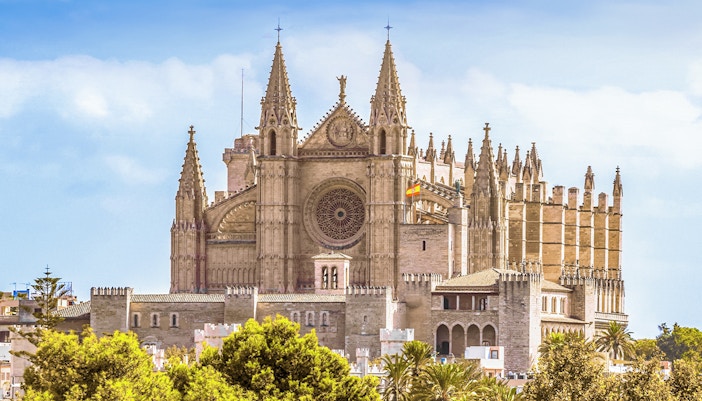
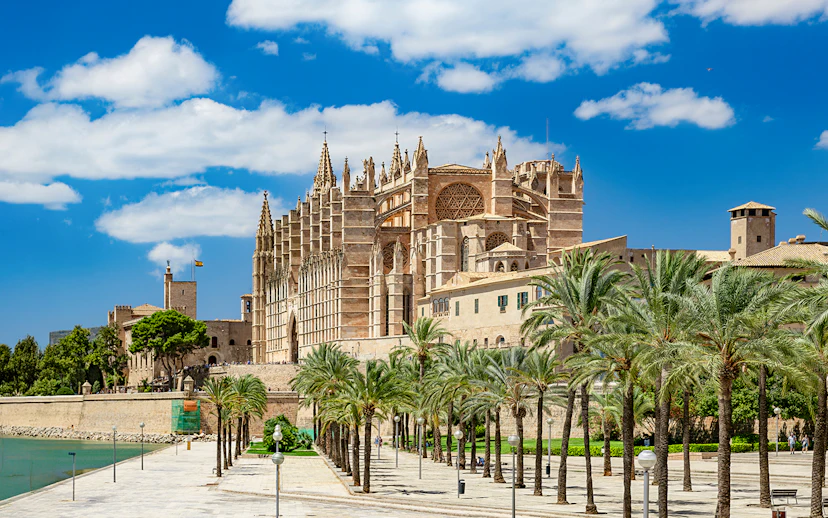
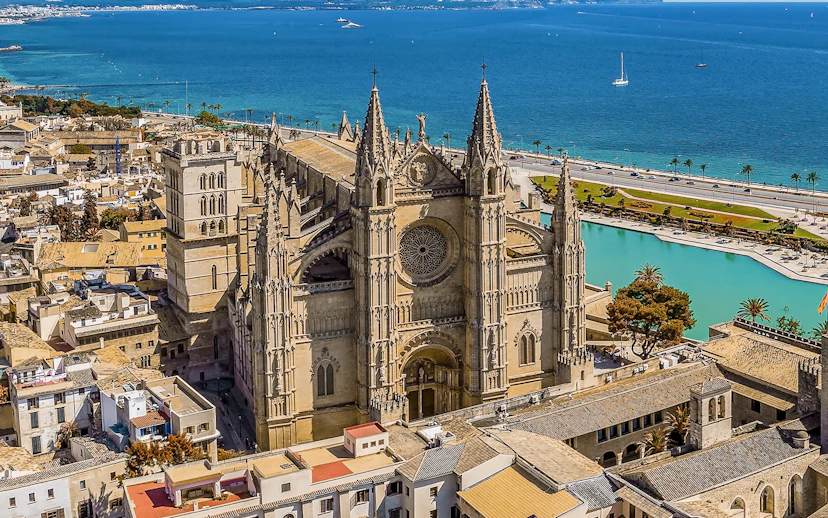
Palma Cathedral (La Seu) is a Gothic seafront cathedral in central Palma de Mallorca, known for Europe's largest rose window and Antoni Gaudí's early 20th-century interior work. The self-guided interior takes about an hour; add the panoramic terraces (open April to October , 200 stairs) and allow up to two hours. The detail most visitors miss: the cathedral closes entirely on Sundays and reduces its hours from November. This guide covers getting there, choosing the right ticket, and what to see once inside.
| Ticket | What's included | Best for | Price |
|---|---|---|---|
Skip-the-line entry | Direct access to the cathedral and Museum of Sacred Art; flexible timing within opening hours | Visiting April to October when a walk-up queue has formed at the ticket window | From €11 |
Entry with terrace access | Cathedral, Museum of Sacred Art, and access to the panoramic rooftop terraces | Visiting April to October and wanting the only view of the rose window from above, across the Balearic Sea (requires climbing 200 stairs) | From €30 |
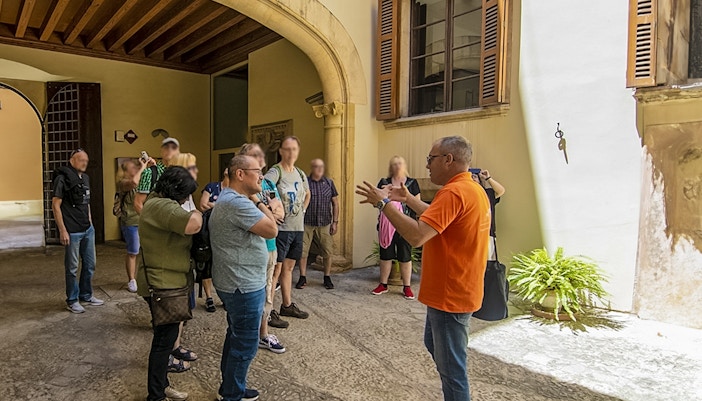
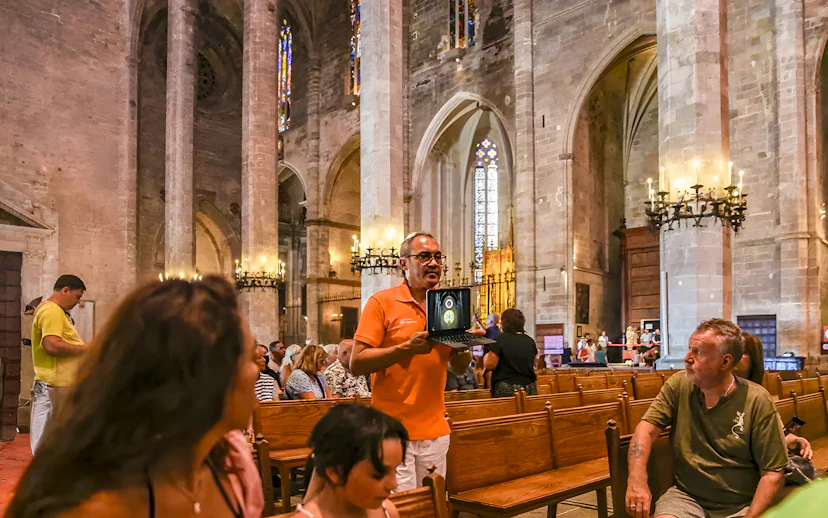
Cathedral and Old Town Guided Tour | Cathedral entry and a 1.5-hour expert-guided walk through Palma's Old Town, available in English, Spanish, French, and German | A first visit where Gaudí's interior changes and the medieval Old Town benefit from a guide's explanation | From €26 |
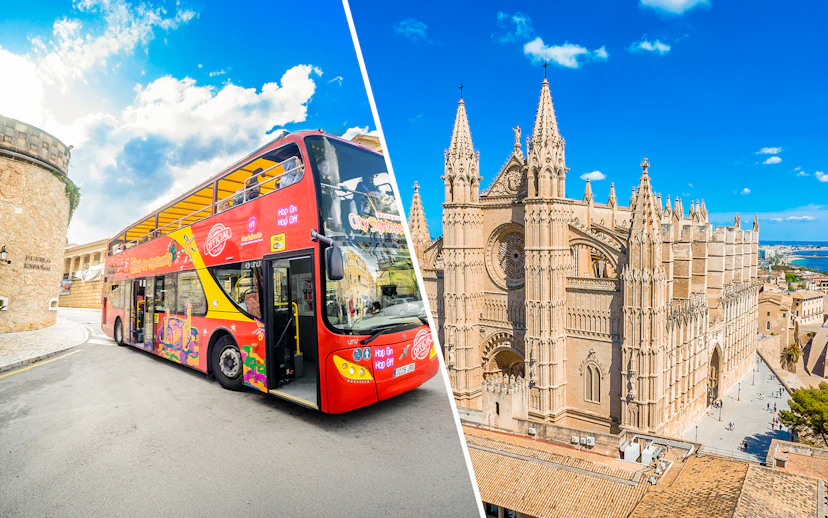
Hop-on Hop-off Bus and Cathedral Combo | 24-hour bus pass (17 stops, Red Route) and cathedral skip-the-line ticket; closest bus stop is Antoni Maura | Covering several Palma sights in one day without managing public transport between them | From €38 |
Palma Cathedral follows a single-nave Gothic layout and can be covered end to end without backtracking. From the Plaza de la Seu entrance, the main nave runs the length of the building towards the altar; the side chapels line both walls. The Museum of Sacred Art (MASM) is accessed through the cloister to the right of the nave.
Audio guides: Available in English, Spanish, French, Italian, German, Russian, and Catalan at the entrance. Included with some ticket types.
💡 Pro tip: Visit the Barceló Chapel before the main altar area. Most visitors enter and walk directly to the rose window end, meaning the chapel is less crowded in the first 20 minutes after opening.


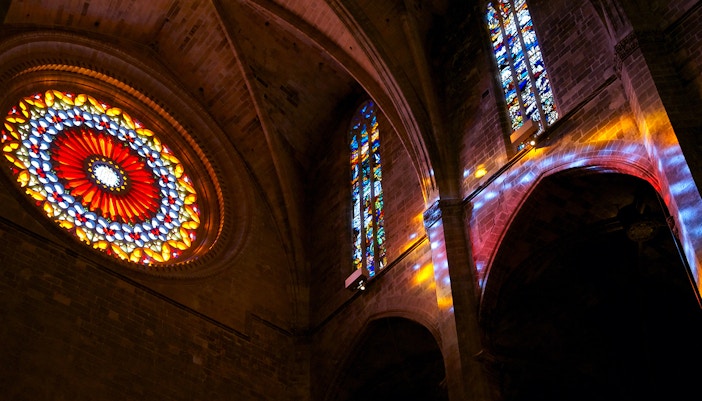
The west-facing rose window is one of the largest Gothic rose windows in Europe, measuring nearly 14 metres in diameter and made from over 1,236 pieces of stained glass. It gives the cathedral its unofficial name, the "Cathedral of Light." Morning light between 10am and noon makes the colours most vivid.
Where to find it: The west wall at the far end of the nave from the entrance.
Twice a year, on 2 February and 11 November, the morning sun aligns with the cathedral's rose windows to project a luminous figure-eight pattern across the nave floor. The event begins shortly after 8:30am and lasts around 30 minutes. It draws visitors specifically for these two dates; arrive at opening to see it before the building fills.
Where to find it: The main central aisle of the nave.
In 2007, Mallorcan artist Miquel Barceló transformed this chapel with a floor-to-ceiling ceramic mural depicting the miracle of the loaves and fishes, intertwined with marine motifs. The scale and colour contrast sharply with the Gothic stonework around it.
Where to find it: Left side of the nave, approximately halfway along, before the altar.
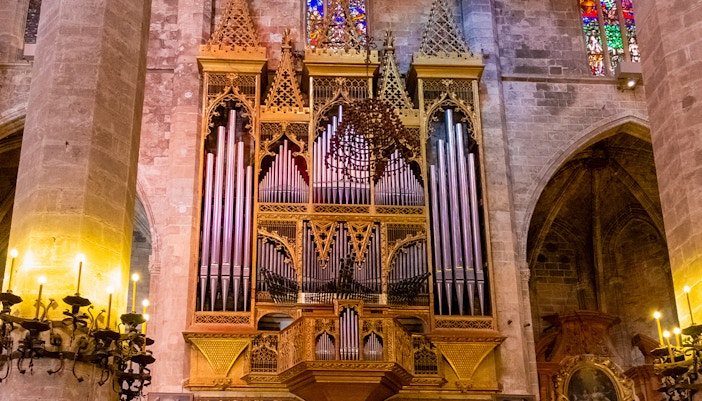
Between 1904 and 1914, Antoni Gaudí undertook a major restoration: he relocated the choir from the nave to behind the altar, added stained glass windows, and designed the wrought-iron baldachin above the altar, which resembles a crown of thorns hung with oil lamps. This intervention is now central to Gaudí Year 2026 events marking the centenary of his death.
Where to find it: The altar area at the centre of the nave.
The terraces give views across Palma's old town and the Balearic Sea from above the nave roof. The bell tower houses nine bells; the largest, N'Eloi, weighs over 4,500kg. Open April to October.
Where to find it: A signed staircase inside the building; requires a terrace-access ticket.
Note: The terraces require a ticket that specifically includes terrace access and are open April to October. After seeing the rose window from inside at floor level, the rooftop view back across the nave and out to the Balearic Sea is the one addition worth planning for.
Accessible through the cloister, the museum holds liturgical artifacts and paintings spanning several centuries, including the Gothic and Baroque Chapterhouses and the Sacristy of the Vermells.
Where to find it: Through the cloister, reached from the right side of the main nave.
Gaudí's baldachin directly above the altar. Many visitors focus on the rose window at the far end and look past this close-up piece of ironwork above the altar table. And the Barceló Chapel — the placard outside is easy to miss, and most visitors who do not read it walk straight past.
⚠️ Dress code is enforced at the entrance with no exceptions. Shorts are the most common reason visitors are turned away in summer. A lightweight scarf in your bag satisfies the requirement for both men and women.
✨ The Palma Cathedral and Old Town Guided Tour combines the cathedral and Palma's Old Town in one 1.5-hour itinerary with an expert guide, without any extra logistics. It covers the cathedral and gives context for the architecture outside it.

Summer hours (April to October): Monday to Friday 10am to 5:15pm, Saturday 10am to 2:15pm, closed Sundays. Winter hours (November to March): Monday to Saturday 10am to 3:15pm, closed Sundays. The cathedral is also closed on several public holidays; see the "Where and when to go" section for the full list.
Weekday mornings at 10am are the quietest window regardless of season, as morning light also hits the rose window most vividly. For overall lower crowd levels, January to March and November are the calmest months of the year. If you want to see the Festival of Light, when the rose windows project a figure-eight pattern across the nave floor, visit on 2 February or 11 November at opening time.
Yes, though driving directly to the cathedral is restricted. The nearest option is Aparcament Parc de la Mar, approximately 600 metres from the entrance, with two further car parks within 1.3km. Spaces fill from mid-morning in July and August, so arriving before 9:30am is advisable on busy days.
Yes, the cathedral nave and the Museum of Sacred Art of Mallorca are wheelchair accessible, with ramps and adapted facilities. The terraces are not accessible to visitors with reduced mobility or cardiorespiratory conditions, as they require climbing approximately 200 stairs.
Yes. The Palma Cathedral and Old Town Guided Tour covers the cathedral and a walk through Palma's Old Town in 1.5 hours. Guides are available in English, Spanish, French, and German.
Yes, access to the terraces is available April to October . A ticket specifically including terrace access is required. From the top, there are views across Palma's old town and the Balearic Sea. The climb involves approximately 200 stairs.
Yes, and it is enforced at the entrance. Visitors must cover their shoulders and knees. See-through clothing, hats, and clothing with offensive graphics are all prohibited. Visitors who arrive without meeting the requirements will be refused entry. Find more details here.
Yes. Mass times are: Monday to Friday at 9am; Saturdays at 9am and 7pm; Sundays and public holidays at 9:55am, 10:30am, 12pm, and 7pm. Note that tourist visits are not permitted on Sundays; the cathedral is closed to general visitors on that day.
Some tickets include a multilingual audio guide. Audio guides are available in English, Spanish, French, Italian, German, Russian, and Catalan. Check your chosen ticket when booking to confirm whether it is included.
No. The cathedral does not have lockers or a luggage storage service, and large suitcases are not permitted inside the building. Leave luggage at your accommodation or at a dedicated luggage storage service in the city before visiting.
Palma Cathedral sits at the edge of the old town, directly on the seafront and adjacent to the Royal Palace of La Almudaina. From the main Plaça d'Espanya transport hub it is around 15 minutes by bus.
Address: Plaça de la Seu, s/n, 07001 Palma, Illes Balears, Spain Find on Google Maps
Spaces fill from mid-morning in July and August. Arriving before 9:30am gives the best chance.
There are two entrances to Palma Cathedral.
Summer hours (April to October)
Winter hours (November to March)
Last entry: 5pm in summer, 3pm in winter.
Public holiday closures: The cathedral is closed on 1 January, 6 January (Epiphany), 20 January (Saint Sebastian), Maundy Thursday, Good Friday, Easter Monday, 15 August (Assumption), 6 December (Constitution Day), 8 December (Immaculate Conception), 25 December, and 26 December. It is open 10am to 2:15pm on 1 March (Balearic Islands Day) and 1 May (Labour Day).
If your goal is the Festival of Light, when the rose windows project a figure-eight pattern across the nave floor, arrive at opening on 2 February or 11 November.
The central vaulted space with Gaudí's baldachin over the altar and the 14-metre rose window at the west end. Allow 20 to 30 minutes here.
Left side of the nave, roughly halfway along. Contains Miquel Barceló's 2007 ceramic mural.
Through the cloister from the main nave. Liturgical artifacts, Gothic and Baroque Chapterhouses. Allow 20 to 30 minutes.
Accessed by a separate signed staircase inside the building, approximately 200 stairs. Requires a terrace-access ticket. Open April to October . Allow 45 to 60 minutes.
Palma Cathedral is an active place of worship and enforces a dress code at all times. Entry will be refused if these requirements are not met.
Required:
Good to know: Scarves wrapped around the shoulders or waist are the most practical solution for visitors arriving in shorts or sleeveless tops. No coverings are provided or sold at the entrance.
On-site: The cathedral does not have a café or restaurant inside.
Better options nearby:
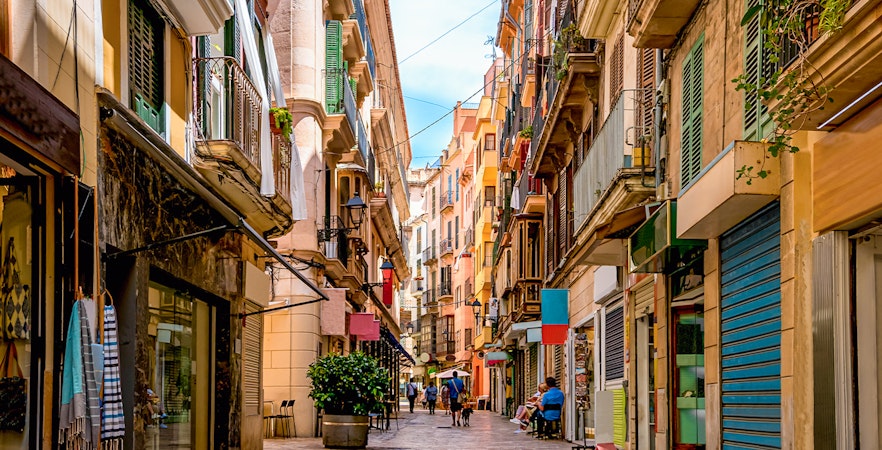
The streets immediately surrounding Palma Cathedral are in the historic centre, walkable and lively during the day. Hotels in this area are predominantly boutique properties priced at the upper end of the Palma range.
Price point: Upper-mid to premium. Best for: Visitors on short trips who want to walk to the cathedral and spend their evenings in the old town. Consider instead: If you are staying two or more nights, the Santa Catalina and Passeig Mallorca neighbourhoods offer a wider range of restaurants, better value accommodation, and are under 20 minutes from the cathedral on foot or by bus.
Inclusions #
Entry to Palma Cathedral
Entry to the Museum of the Cathedral
Access to the terraces (based on the option selected)
Exclusions #
Live guide
Transport
Please click here for the detailed route map and boarding points. You can join the tour at any stop and hop on and off for the duration of your ticket.
Mallorca Hop-on Hop-off tour - Red route
Inclusions #
Mallorca Hop-on Hop-off
24-hour unlimited hop-on-hop-off bus pass by City Sightseeing
Access to Red Route
Audio guide in English, Spanish, French, German, Italian, Chinese, Russian, and Catalan
City map
Free headphones
Branded cap
Palma Cathedral
Skip-the-line entry to Palma Cathedral
Entry to the Museum of the Cathedral
Skip the lines & dive into Palma's history with an expert monolingual guide.
Everything you get: A guided walking tour of Palma’s streets, history, and hidden features like the underground tunnels by an expert in a choice of four languages. Skip the lines as you tour the palatial Palma Cathedral and the Museum of the Cathedral in a small group of no more than 5 people.
Why choose this: A single ticket that gets you a well-rounded understanding of the history of Palma and a tour of its most well-known landmarks.
Inclusions #
Exclusions #